
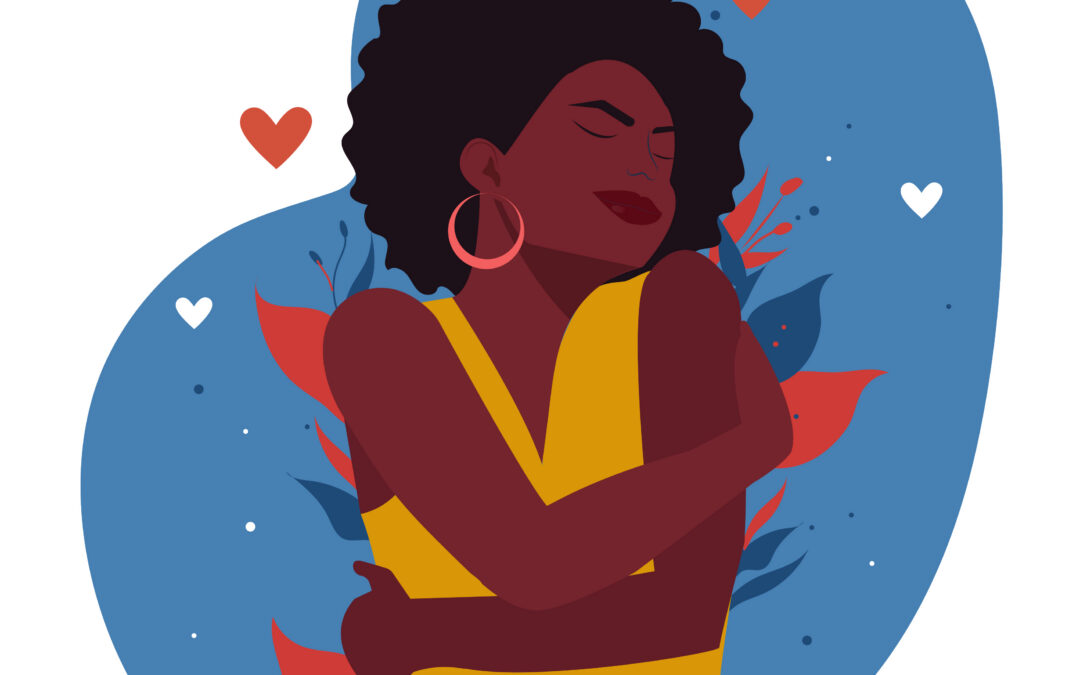
Learning to fully accept yourself is an important step not to skip when working toward feeling better about yourself. If there are things about yourself that you do not accept, it would be very hard to accept good things that may come your way. You may end up wondering if you truly deserve to be happy or feel like an impostor.
Here are some obstacles that may be preventing you from self-acceptance:
– Comparisons: You tend to compare yourself to others, compare yourself to how you used to be, compare yourself to social expectations, or compare yourself to your own unrealistically high standards.You may notice a lot of thoughts of “should” or “should not”.
– Perfectionism: You may believe that accepting yourself as is would prevent you from reaching your full potential or would limit your effort in pursuing your goals. You may incorrectly believe that striving for perfection is what would help you feel better about yourself. However, the impossible pursuit of perfection would likely result is more harsh judgments toward yourself.
– Beliefs from childhood: When you were a child, your understanding of people, life, and what is normal was limited to what you experienced with the people who surrounded you. You learned about what is and is not acceptable and those beliefs can really feel like the truth. You may carry those beliefs into adulthood without truly questioning them. It may be difficult to allow “unacceptable” parts to exist.
– Shame: Shame can be a powerful feeling that prevents your from truly looking at yourself. It may lead to avoidance or defensiveness. You may end up distracting yourself to not have to acknowledge aspects of yourself that you do not like
– Experiences of invalidation: You may have had experiences in life that were invalidated by others or society. For example, you may have had a traumatic experience that others minimized or denied. You may end up invalidating yourself by not trusting how you actually feel or think, and believing that the traumatic experience was no big deal.
– Systemic oppression: Experiencing systemic oppression such as racism, sexism, ableism, fat phobia, or trans phobia for example could lead you to develop survival skills. To survive, you may feel the need to hide who you truly are, strive to be someone you are not, or just disconnect from yourself.
How to build self-acceptance?
A helpful strategy to build self-acceptance is to explore who you are, and develop a more in depth, nuanced, and expansive sense of self. You can start by gaining more understanding of the blocks to self-acceptance and develop more self-compassion.
Imagine your self-identity is a little cloud in the sky. To explore who you are, you can zoom in to see more details. See the cloud as a three dimensional object. Look at how the edges are not quite as clearly defined as what you thought at first glance. Look at how some parts of the cloud are more dense and some are see-through thin. Observe how the cloud moves and transforms over time. You too have some parts of you that feel quite solid and some that may be less important. For example, your identity as a mother may be quite prominent, but your identity as a coffee drinker is much less significant. The coffee drinker part is still a part of you even if it is really small. Allow aspects of yourself that are contradictory or exceptions to exist as well. Use curiosity to really examine everything. Allow your self-identity to be much bigger than what you were told or believed about yourself to include everything, especially the parts that are disliked, rejected, silly, taboo, or useless. Do not forget to acknowledge the positive aspects of yourself that may have been ignored, dismissed, or minimized because you were not safe enough to accept them. They all make up who you are.
Practice this process of self-exploration over and over. Take notice of times when you have a strong reaction to being judged a certain way by others or when you criticize yourself harshly. This hard work will hopefully create a path to live a more authentic and healthy life.
If you’re working toward greater self-acceptance and would like support along the way, the counselors at Star Meadow Counseling are here to help. We provide compassionate, affirming counseling to help you better understand yourself, challenge self-criticism, and build a more authentic relationship with who you are. Reach out today to schedule an appointment and take the next step toward embracing yourself with greater confidence and care.

How to Gear Up for an Awkward Conversation
Years ago, I was the guitarist in a rock band. Well, okay, the term “rock band” might be a bit of an exaggeration. It was really a group of fresh-faced college students playing children’s music at local parks. The trouble was, our drummer had just learned some fancy...
5 Questions to Uncover Your CORE VALUES
Core values are words that describe a person’s inner compass. Core values provide people with direction when they feel stuck, lost, or at a crossroads. They help you prioritize what’s really important in life. They reflect what gives a person their sense of meaning...
Quotes to Inspire Self-Acceptance
“You either walk inside your story and own it or you stand outside your story and hustle for your worthiness.” “The hardest challenge is to be yourself in a world where everyone is trying to make you be somebody else.” “The most beautiful people we have known...

Walk to Fight Suicide
Star Meadow Counseling is proud to help sponsor the 2017 Out of Darkness Community Walk. We have seen the impact that suicide can have on friends and family and are committed to spreading a message of hope to those that are suffering. Every 40 seconds someone in the...

Body Acceptance: PART 1—An Unexpected Lesson From Star Wars
Anyone that saw the movie poster for Star Wars: Episode One could have been easily mislead into thinking this would be an epic movie. The image of Darth Vader's shadow lurking beside the figure of innocent Anakin Skywalker is thought-provoking and thrilling! Yet,...